
The art of rebuilding a face: a conversation with anaplastologist Suzanne Verma
Suzanne Verma is a certified clinical anaplastologist and the founder of Advanced Prosthetic Restorations in Dallas. Her work sits at the intersection of medicine, technology, and fine art: she restores what cancer, trauma, and congenital conditions take away: an ear, a nose, an orbit, in one case nearly an entire face. She has partnered with MedCAD on more than 20 cases.
Suzi (as she’s known by our engineers) has worked with MedCAD to create patient-specific anatomical models, a step that compresses weeks of manual impression-taking into days. We talked about the craft, the psychology, and where the field is going.
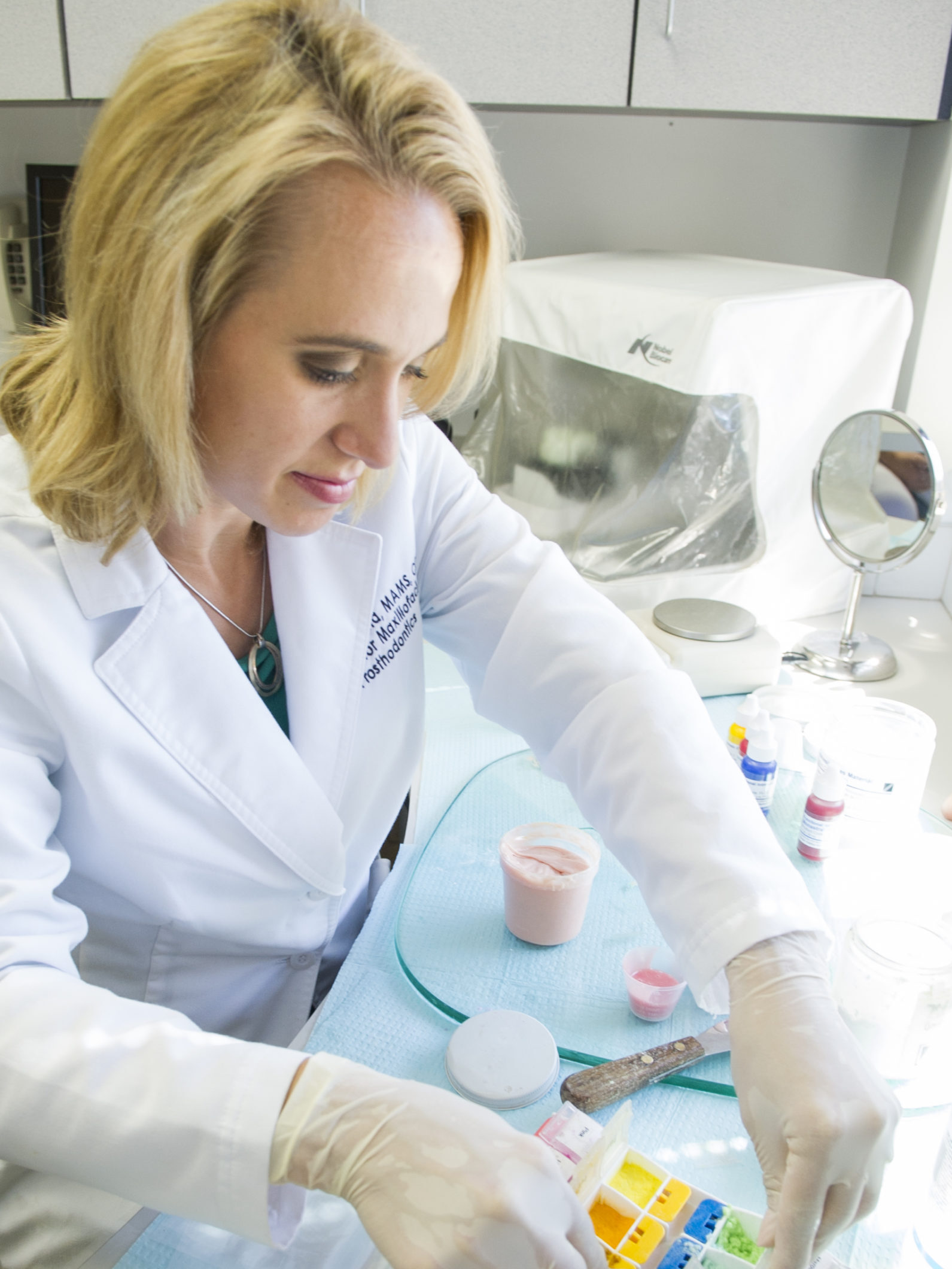
Q: What is anaplastology, and what does your practice look like on a day-to-day basis?
Verma: Anaplastology is the art and science of restoring a malformed or missing part of the human body through artificial means. I practice it through prosthetic reconstruction and rehabilitation. Most of my patients have acquired facial defects through cancer resection, invasive infection, or trauma. Others have congenital malformations like a missing or malformed ear, which is more common than people realize.
Most of my referrals come from plastic surgery, surgical oncology, ENT, and oral maxillofacial surgery or from pediatricians for congenital cases. I see patients from young children to those in their later stages of life. I often stay with a patient for life: as they grow, as their face changes, as they have future surgeries, the prosthesis evolves with them.
An anaplastologist is both the clinician and the lab technician because we create everything. I run all the clinical appointments, do all the sculpting, and I’m in the OR with the surgeon when we place the implants. I spend a lot of time with patients often at least six clinical appointments and about six days in the lab. When someone comes in from out of town, I’ll book the whole week and see them from morning to close. I get to watch their confidence come back. What I’m making is a physical part but the healing is emotional too.
Q: You’ve partnered with MedCAD about 20 times so far. What makes you decide to bring us in on a case?
Verma: Each step is easier with a digital workflow.
Usually a patient will have a CT scan as part of their surgical planning, because we’ll be placing craniofacial implants (similar to dental implants, but very small) into the remaining bone. These implants let patients retain the prosthesis magnetically so they can remove their ear or nose independently, as needed.
I’ll have either the CT data or a traditional impression and model. I send that to MedCAD, and the engineers mirror the anatomy and create a 3D-printed prototype. I then duplicate it in sculpting wax and bring it into the clinic. I actually sculpt on the patient. I have a lot of clinical hours where I’m inches away from them, sculpting their ear or their orbit. Then there’s the entire process of making it in silicone, using the lost wax technique.
Then I paint. I match all of the colors found in their skin down to freckles and blood vessels, layer by layer into the mold. It processes and comes out as a flexible silicone prosthesis. MedCAD accelerates that first step. I’m able to capture the exact form and size I need before I ever start sculpting.
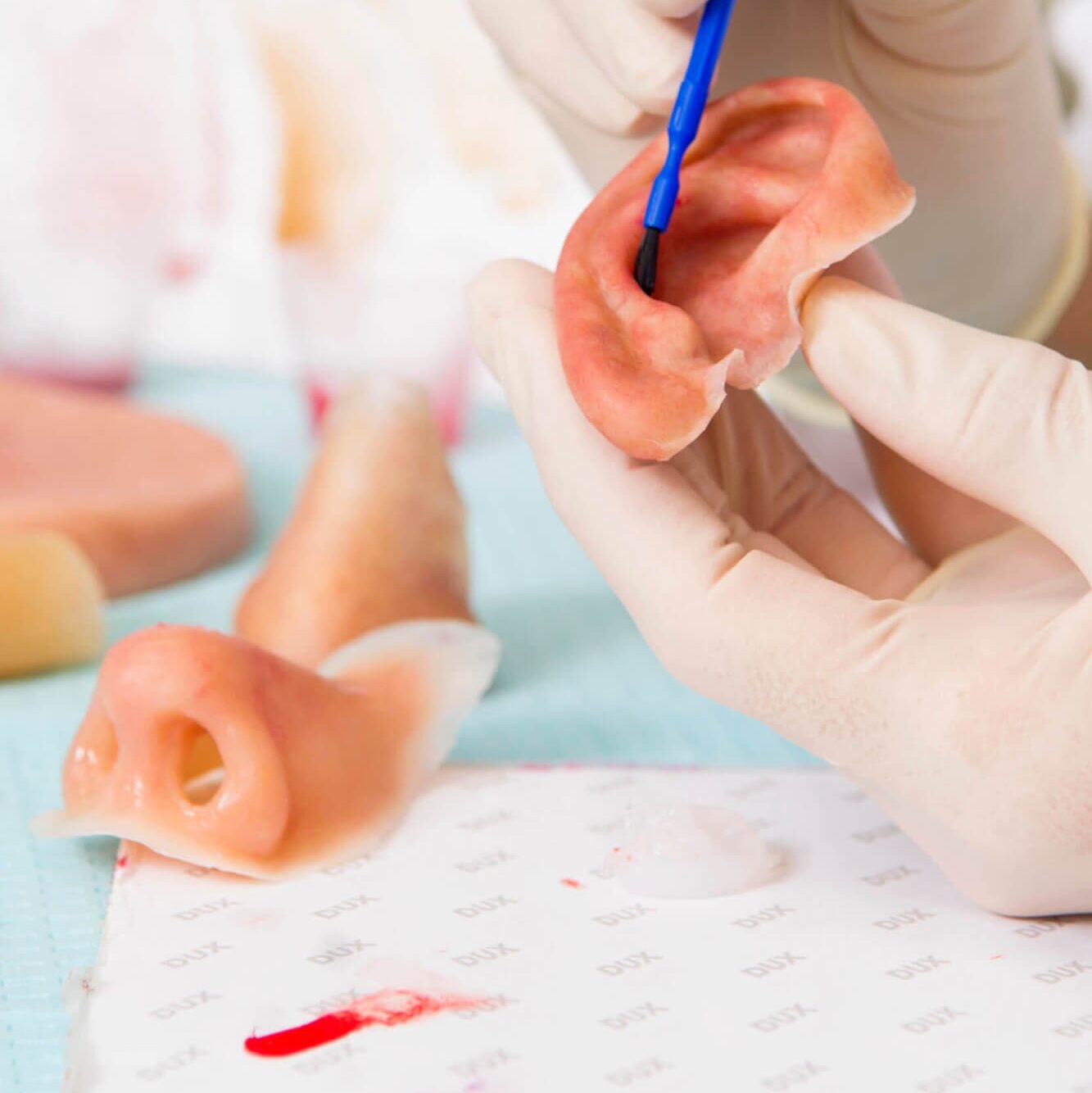
Q: What things do you have to consider other than cosmetic aspects?
Verma: What I make affects a patient’s life, their work, and their self-confidence. We always try to make clear that this isn’t just a cosmetic piece. Many carry real functional importance. A nasal prosthesis after rhinectomy, for example, protects open sinuses.
It can also help them perform their jobs safely-wearing glasses, safety masks, and the equipment their work requires. But a lot of it is about being a whole person again and getting their confidence back.
Q: How do your patients react when they get the prosthesis?
Verma: That’s my favorite thing. I love delivery day. I had one just recently, and we were jumping up and down. Sometimes there are tears. Everyone reacts differently.
I once made just the tip of a finger for someone, and she was so overjoyed she wanted to walk around the whole hospital and show everybody. But other people who are missing something small want no one to notice and they hold the work to exacting standards because of it. Then there are patients with significant defects who have made peace with their appearance and are not looking for concealment so much as they want function and fit. So you must understand their comfort level from the beginning, and work with it.
With little kids I’ll say: let’s think through some scenarios. You’ve got a pool party coming up, who’s going to be the buddy that dives in to find your ear if it comes loose on the cannonball?
With adults, it’s about their interests. If someone wants to ride a motorcycle, we talk about what helmet fits over the prosthesis. I had a patient who wanted to go scuba diving. My first instinct was to say, “Ocean? Let’s leave it in the safe box.” But I ended up getting her into a full-face mask so she could wear her orbital prosthesis in the water. Every patient is different. You really have to understand their needs and their comfort level.
Q: What are some of your most challenging cases?
Verma: The most challenging case I’ve ever had is also the most rewarding. It was a full-face prosthesis — forehead to upper lip, temple to temple. The patient had lost all his facial anatomy due to mucormycosis — a flesh-eating fungal infection — within four hours. His wife documented it as it happened. I worked with his surgical team across three states to build the prosthesis.
I became very close with him and his family. He has since passed away, and they asked me to give the eulogy at his funeral. We’d made video clips over the years as he always wanted to tell his story on camera. So, I gathered those: him talking about his family, his faith, his own testimony. This work means I get to become part of the healing, not just the physical part, but the spiritual and emotional healing too. For the patient and for the family.
“I became part of the healing — not just the physical part, but the spiritual and emotional healing too.“
Q: How did you get started with anaplastology?
Verma: I figured it out in high school, which I know sounds strange. My parents had a subscription to National Geographic, and there was an article about someone making an orbital prosthesis. Just a picture of someone holding an eye in their hands. I wrote a letter to the author: “How do you get to this field?” They wrote back and walked me through it.
I visited graduate programs first and asked what to study as an undergrad. The answer: double major in pre-med and fine arts.
One school in the country had a program called Biological Pre-Medical Illustration: Iowa State. So I went there and spent four years on pre-med coursework alongside figure drawing and color theory. Then I went to the graduate program at the University of Illinois at Chicago, focused on 3D and facial prosthetics, and came out with a master’s degree. From there I went to Edmonton, Alberta, to work with what’s now the Institute for Reconstructive Sciences and Medicine — early innovators in digital technology for prosthetics.
When I moved to Dallas, I joined what’s now Texas A&M College of Dentistry, where I was on the oral surgery faculty for 17 years in a multidisciplinary team setting. I still teach a course there, but I’m now in private practice in Dallas.
Q: What do you see in the future of anaplastology?
Verma: There’s a lot of conversation in our field right now about where we’re headed. When digital technology first arrived, some practitioners feared it would displace the art, or the field entirely. I’ve always believed you embrace it as a partner: use it to make the process faster, more efficient, more predictable.
Different practitioners are taking different approaches. Some colleagues are digitally designing and printing the mold directly, instead of the traditional lost wax method. We’re still refining it, the conventional techniques took decades to perfect, and the digital equivalents are catching up. As the technology improves, we may see printers that can output color in a soft, flexible, translucent material, something that genuinely approximates skin.
That could extend access to patients in places where there is no anaplastologist, remote, underserved communities that currently have no options. But I’m a firm believer that the physical part is only part of the work. Patients need a person to connect with. If they just receive a part and put it on without that relationship, they may never fully accept it as part of themselves.
I put enormous value in that personal relationship, the involved clinician who walks alongside the patient. So, I hope to see technology reach more patients in need. But I also hope we keep the human aspect to help heal them — body and soul.
Q: How did you find Nancy and MedCAD?
Verma: I met Nancy before I even moved to Dallas, around 2003. She was working with Freeform software, and I’d gone to a conference in graduate school where I first encountered haptic design systems. I believe we met at a trade show. I had no idea I’d be moving to Dallas years later. But we stayed in touch.
Once she started MedCAD and I moved to Dallas, we reconnected. I hosted an international conference for our field in the Dallas–Fort Worth area and asked Nancy to help put together a reception. We brought in local artists working with digital tools and haptic systems — the pieces were all 3D printed. The idea was to open a conversation about the thread that runs through all of it: art, technology, and science, and what happens where they meet.