
New Technology Heals a Very Old Injury
For almost fifty years, a Dallas man lived with pain from a childhood ankle injury. With a big assist from MedCAD’s patient matched, 3d-printed componentry, a surgeon has helped him heal half a century of accumulated damage. Here’s Big John’s story.
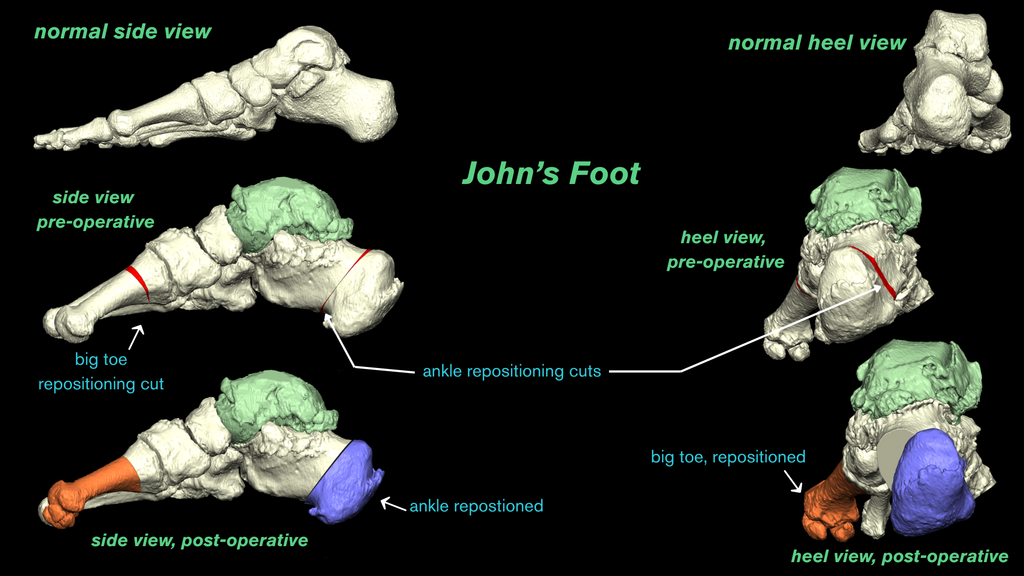
Nearly 50 years ago, a 13-year-old John Kurkjian injured his ankle playing stickball near his home in Queens, New York. The ankle wasn’t broken, and doctors diagnosed what they believed was a high ankle sprain with stretched ligaments. As he grew, John went through his days with an ankle that was severely twisted sideways. For nearly five decades — and, eventually, as a 6’ 6”, 300-pound adult—he compensated by walking on the outside edge of his foot.
“Walking on the edge of my foot became kind of normal for me,” John says, who is now a systems analyst living in Dallas.
“The injury kept recurring over time and I just learned to live with it.” – “Big John” Kurkjian
But that abnormal gait took an increasing toll. In the last 20 years, John experienced severe pain and progressively limited mobility. He couldn’t comfortably walk up or down inclines, stopped participating in sports and repeatedly re-injured the ankle. Eventually, his episodes of pain became longer and more debilitating. Years of compensating for the ankle deformity had also contributed to problems with his lower back.
John’s wife, a registered nurse, convinced him to see a doctor. They met with a podiatrist who recommended fusion surgery, but John wanted to preserve as much function in his foot as possible.
Then John met foot and ankle surgeon Dr. Calvin Rushing of the Dallas Orthopedic and Shoulder Institute. Dr. Rushing recognized reconstruction as the ideal solution, but also knew what an extraordinarily difficult challenge it would be to rebuild an ankle that had been deformed for decades.

He wasn’t wrong. Dr. Rushing performed a complex outpatient reconstruction involving 11 surgical procedures, culminating in a total ankle replacement. A critical part of the operation was the use of 3D-printed patient-specific surgical pathways engineered by Dallas, Texas-based MedCAD, which were designed specifically around John’s unique anatomy and deformity.
The custom technology helped Dr. Rushing plan and execute the reconstruction with greater precision while reducing operative time — particularly important in a case with such extensive deformity and altered anatomy. MedCAD’s precise guides ensured that every cut, every shave, every screw and attachment were placed precisely where they should be to rebuild John’s ankle. Patient-specific splints, guides, and models allowed Dr. Rushing to do his best work for such a demanding reconstruction.
“My mind was blown,” Dr. Rushing says. “Five years ago, a procedure like this could not have been attempted; with the engineering capabilities we have today, I believe this type of patient-specific reconstruction will become the norm for complex procedures like this.”
Today, John is walking pain-free for the first time in nearly 50 years. For him, the technology isn’t an abstract medical innovation. It means being able to walk without hurting every step.
Dr. Rushing says the case also points toward where foot and ankle surgery is headed.
“The future of 3D patient-matched custom jigs, guides and plates is going to exponentially grow,” said Dr. Rushing. “Without this new technology, we’re doomed to experience the same failure rates for these complex procedures that we’ve seen the past 30 years versus the improved rates that we’re seeing over the last five or so years using this new technology.”