
“I’ve done your surgery prior to you even getting on the operating table”: A conversation with Dr. Samir Singh
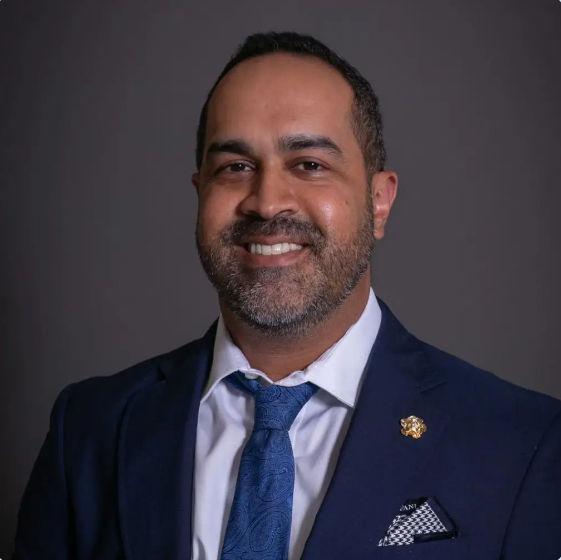
Dr. Samir Singh is a board certified Oral and Maxillofacial Surgeon and a member of the American College of Surgeons (FACS). He’s part of a new wave of surgeons integrating digital surgical planning and additive manufacturing to achieve outcomes once thought impossible. He has worked with MedCAD on 27 cases (and counting), and was an early adopter of our AccuPlate orthognathic plating technology.
We asked him about his practice, his passions, and his experience working with MedCAD on some of his most difficult cases.
Q: What made you want to become a dentist and a surgeon, and how did you make it happen?
Dr. Singh: I primarily grew up in Pittsburgh, Pennsylvania, and came from a family that had a strong academic background. My father’s a PhD and an endowed chair professor at the University of Pittsburgh Medical Center. I had a good role model in him.
I progressed through the stages of life from wanting to be Batman to being a car mechanic to finally sort of finding my path in college. I majored in neuroscience, which I found to be supremely fascinating, and I did well academically which opened some doors for me. I have a sort of artistic nature, and it turned out that dentistry is the perfect combination of didactic knowledge and artistry and hand skills.
At dental school, I got a keen interest in oral and maxillofacial surgery pretty early on. I remember approaching Dr. Mark Ochs, one of my personal mentors, as a second-year dental student and saying that I wanted to spend some time with him in the operating room, and he looked at me and said, “Be careful, because you’re going to get hooked, and then you won’t want to do anything else.” And sure enough, I got hooked and I didn’t want to do anything else. So once I graduated dental school, I did my four-year residency at one of the top programs in the country, at Virginia Commonwealth University, where I trained in extensive facial maxillofacial trauma reconstruction orthognathic surgery, which is a big part of my practice, as well as dental alveolar surgery, dental implants, and things of that nature.
I landed back home in the Pittsburgh area, and I’m in a group practice with six surgeons called North Pittsburgh Oral Surgery.
Q: Do you have a favorite treatment or procedure?
Dr. Singh: Oh my gosh, I love it all, honestly.
Within the office, I actually am a Key Opinion Leader for ZimVie, so I do a lot of lecturing on full arch implant therapies. For folks who present with terminal dentition — where not all of their teeth can be saved — we have the technology to sedate patients in the office, remove the teeth, place dental implants, and use a lot of principles of virtual surgical planning to 3D print temporary teeth in the office and deliver them the same day. These folks come in kind of hopeless leave with some tears and a smile.
Within the operating room, I absolutely love orthognathic surgery. Our results aren’t always immediate, but on the table, we can see the immediate difference when we’ve done a large procedure. Then we actually get to follow them for six-plus weeks after surgery, so we get to see the transformation. That is both professional and personally rewarding.
Q: When dealing with the face, there are more considerations than with something like correcting a bunion. Can you talk about that balance between form and function?
Dr. Singh: As maxillofacial surgeons, we’re very in tune to that — and the dental background really contributes to this, because when you’re working on a tooth, you’re looking at fractions of a millimeter and fractions of a degree that can make all the difference in the world. That sort of very keen and critical eye translates to the surgery.
We’re trained to critically evaluate all the proportions of the face. We know typical norms, but there’s no true and solid answer for every patient. You have to truly assess their chief complaint, their needs, their aesthetics in order to determine the movements. So, for instance, I had a young lady who had a double jaw surgery. She was truly mandibular prognathic, and it was pretty significant, about six, seven millimeters. So in evaluating her facial thirds and fifths — looking at the upper third, middle third and lower third as well as the horizontal fifths — I felt uncomfortable setting her mandible back that far for the fear of potentially introducing sleep apnea.
So we split the difference in a double jaw just to make it a little more palatable for her. And her profile looks absolutely stunning. We didn’t disrupt any function; her breathing is just as good as it ever was. So it’s moments like that where someone may tell you, oh, no you have to move the upper jaw forward because it’s a maxillary issue. Well, let’s take a step back and evaluate the patient as a whole. You have to have an artistic eye to deliver a quality result.
Q: How important are patient-matched custom implants to this approach?
Dr. Singh: The patient specific implants are such a game changer. For orthognathic surgery, we do the virtual surgical planning well in advance. My typical workflow is to assess a patient’s chief complaints are at the forefront. Then we delve into functional issues: speech issues, temporomandibular joint issues, myofascial pains, things of that nature. Then I take a very detailed set of measurements to assess the soft tissue drape over the maxilla and mandible. Once we do that, and once the patient is somewhat ready for surgery, I’ll evaluate the clinical facial photos.
And as the orthodontist, we’ll do what’s called a decompensation of the teeth. If someone has a large underbite, the teeth are quite intuitive and will actually shift in the opposite direction to try to mask or camouflage that dental facial deformity. So the job of the orthodontist is to place the teeth in the correct position within the jaw. So oftentimes from the initial consultation to the pre surgical workup, their facial features will change — in fact, the underbite will probably worsen. So I typically do my virtual surgical planning at least a month prior to surgery just to make sure that everything is locked in.
I tell my patients, I’ve done your surgery prior to you even getting on the operating table, because I’ve utilized technology and the very intelligent engineers at MedCAD to help me make these movements. We’ve planned it down to a fraction of a millimeter. We don’t accept anything less.
Before virtual surgical planning, we would take a two-dimensional x-ray and acetate paper and actually move it and use colored pencils to plan. I mean, it’s crazy. It is absolutely crazy. When I was in training, virtual surgical planning was just getting off the ground. We would take plaster models of the dentition. We would mount them to articulators, and then we would have to cut the models and glue them and reset the bite. We’d make our own splint. When I was one of the chief residents at Virginia Commonwealth University, if I had 4 or 5 orthognathic cases a week, I would spend eight plus hours in the lab, just prepping for cases, simulating those movements on stone models, and then actually using a boiling pot to make an acrylic splint and trimming them down.
Now I could do it over lunch.
“I tell my patients, I’ve done your surgery prior to you even getting on the operating table, because I’ve utilized technology and the very intelligent engineers at MedCAD to help me make these movements. We’ve planned it down to a fraction of a millimeter. We don’t accept anything less.”
Q: Are most of your cases straightforward, or are they all challenging in different ways?
Dr. Singh: I’m a magnet for the tough cases. I joke that I want to meet the surgeons that are getting the easy ones and see what they’re doing.
Q: What’s your experience with surgical time using patient-specific approaches?
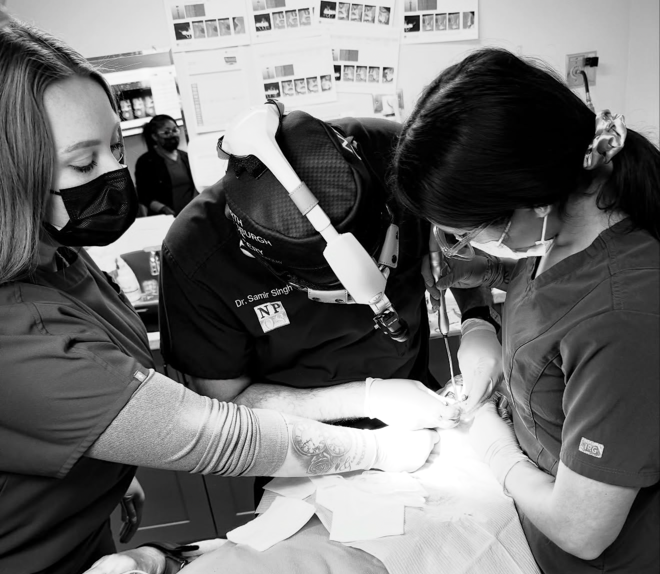
Dr. Singh: So I’m kind of a dork. When the cutting guides and the patient specific implants came out. I actually had my rep time me to see how long it takes me to bend plates. Intraoperative, it was 35 minutes to bend, contour, secure the plate. Whereas now, it’s like the plate just melted on, you know? You have a level of precision that hasn’t been evident in orthognathic surgery. So when I was a resident, these cases — and granted, I was in training — these cases were taking 5 or 6 hours for a double jaw. I certainly don’t rush things now, but I think the fastest we’ve been done plating is 2.5 hours, close to three hours for double jaw. And I’m not saying that to brag. I’m just commenting on the efficiency of the technology.
Your design team, our circulating nurses or scrub nurses, OMF managers that prep for cases ahead of time… I mean, it’s a full team and they do a fantastic job. I can’t speak highly enough about the team around me. And my gosh, my partners. These are two-surgeon operations and they’re the absolute best.
Q: Where do you see your area of practice going from here? What’s the next step?
Dr. Singh: AI. I see software that analyzes facial features and does proposed movements. Obviously, it would need to be overseen by a surgeon, but I see AI helping with the treatment, planning, and even adapting a plate based on a surgeon’s preference list. Some algorithm that predicts “oh, he likes this cut,” so it takes two seconds to do the deliverables and design the plate. I think it will be here sooner than later.
Q: How about during surgical procedures? Is there any technology that’s going to help you move around the OR?
Dr. Singh: Minimally invasive orthognathic surgery — that can reduce the swelling, the numbness, and the discomfort postoperatively, and I think there’s a big market for that. So whether that’s endoscopic procedures or robotic procedures, it’s going to be pretty interesting to see what the next 20, 30 years look like.
Q: What are you doing with all this time you save?
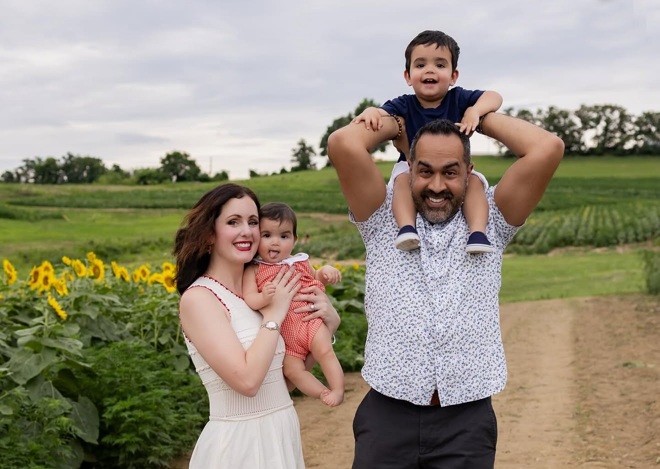
Dr. Singh: People always joke with me, “in all your spare time,” as if I have any. I was a part-time faculty member at the University of Pittsburgh, so I participated in maxillofacial trauma at three level one trauma centers for about seven years, starting my career. But, when I’m not doing that, and working, and speaking as a KOL, I have a beautiful wife and two beautiful children that I absolutely adore and love spending time with. My wife Suzanne is fantastic. We enjoy traveling. We enjoy spending time with the kids. My son Dev is two. He’s a little chatterbox, and he’s absolutely in love with his little sister, Liya, who’s about nine and a half months.
Q: What’s the best part of your job?
Dr. Singh: Oh my gosh, the people. I mean, just being able to help. People come to the surgeon, and they don’t often get good news. And one of my toxic traits is I never say no. So when I tell people, “Look, I don’t have the answer right now, but I will have the answer. And if I don’t, I will find you somebody who has the answer for you.” So just being able to offer a wide variety of services to these people and truly help — to see their journeys — is great.
And selfishly, I love the volume and variety of what I do. Every day looks totally different for me in the operating room. And I enjoy the relationship with my partners and my staff. But it’s the people. That’s what keeps me going and keeps me honest. When my kids were born, patients would come in and drop off things. “Oh, here’s a onesie. Here’s a card, or here’s a big brother-little sister matching pair of outfits.”
I mean, that’s what keeps me going, 100%.